pub
-
README - overview ProOps Framework
Proceeding Operations and Change Control Framework
The Components overview is the entry point for documentation, configurations, code, tests, acceptance and change controls. The framework is a lean integration of quality systems from multiple industries (GAMP-5, OODA Loop, DevOps/Agility, CI/CD, Shift Left testing, FIPS/RMF, Swiss Cheese safety model, Multi/Dual-Vee, 5S, Iceburg and Spiral), for efficient, ongoing development. The framework is a template for organizations interested in addressing or preventing technical debt without a particular governance or compliance requirement. Adaptation to specific GRC needs, should be straightforward.
The framework is a four phase, continuous feed forward, development model. Each phase is divided into three scopes, for broader, middle and finer details. Each phase orients the next with inputs. Direction is taken from the prior phase and calibration is from the phase two steps away. The handoff recipient provides respective acceptance.
The phases are Risk analysis, Design plan, Execution implementation and Check quality. From any starting point, they loop in that order. Components are represented in each phase according to the development within that phase, an Index locates component representations within each phase and a Resource document contains a site Glossary, Acronym table and bibliographic Reference sections.
Typically, project source code will iterate development and live in a version control repository. Eventually, project complexity or collaboration needs will create risk factors that are addressed by creation of design documents and quality checks. A well developed project will document the risk factors, in addition to the design and check phases.
Generally, individuals will have more expertise in one phase, and less in the other three. Understanding the scope and level of development are the first steps in document interpretation. The scope classification prepares the handoff recipient and aligns development, across phases. Just as a document’s scope and relevance are the first technical assertions made, so should they be identified for interpretation across areas of expertise, in phase handoffs.
The coordination between risk and execution; as well as the design and check relationship, is calibration and a key elucidation of the framework. In complex projects, this relationship contributes to a smooth, focused migration from development to production operations. Proceeding development, with the framework pattern as a target, sets the stage for coherent operations. While, ad hoc execution development can progress with assumptions of undocumented design, non-existent quality checks, and no risk analysis; a disposition of phase loop interaction is prerequisite to actually achieving development agility.
| Output | Drives | Output | Drives | |
|---|---|---|---|---|
| 1 | Exec | Check | Risk | Design |
| 2 | Check | Risk | Design | Exec |
| 3 | Risk | Design | Exec | Check |
| 4 | Design | Exec | Check | Risk |
| 5 | Exec | Check | Risk | Design |
| 6 | Check | Risk | Design | Exec |
| … |
The above handoff table represents the four phase development loop, which can start from any state. From day-one to day-1000, the disposition of each phase (specific input directing the designated handoff), never changes. Consideration of the phase handoffs facilitates loop initialization and phase integration. A simple way to view the relationships is execution considers risk factors, while check considers the design plan, in their respective efforts. The following is a more detailed view, of the handoff cycle.
- Executions are evaluated by quality checks which indicate if the design plan addresses the risks analysis.
- Quality checks are evaluated by risk analysis which indicate if the executions addresses the design plan.
- Risk analysis are evaluated by design plans which indicate if the quality checks addresses the executions.
- Design plans are evaluated by executions which indicate if the risks analysis addresses the quality check.
- Executions are evaluated by quality checks which indicate if the design plan addresses the risks analysis.
- …and so fourth
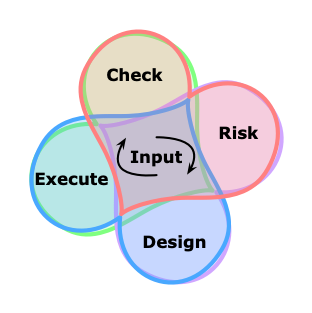
Initially, there may be no handoffs or documentation at all. If there is no development in the other phases, consider interaction with the other phases as a pass-through loop, to prepare for future phase handoffs and orient the efforts.
Handoff classification, as broader, middle or finer detail, facilitates integration with the other phases. When the project matures toward the framework, handoffs align like three concentric circles representing the degrees of detail, the finer handoffs represented by the inner loop, while middle and broader handoffs are represented by larger circles, looping simultaneously, in a clockwise direction.
An initial handoff will be ineffective, if the recipient builds for a misunderstood scope. In practice the different phases will begin their efforts in opposite levels of detail. It is important to understand the handoff recipients don’t have the same expertise as the handoff authors! For these reasons, it is imperative to classify handoffs as broader, middle or finer detail, to properly orient the recipient for alignment with their efforts and integration.
Generally, a framework project will begin in the the risk and design phase by itemizing broad levels of detail as business objectives (risks) and platforms (design); while specific finer details, such as OS/software and versions, will be the first to emerge in the execution and check phases. Reporting undirected initial phase development conveniently advances the choice for adoption by the driving phases. As risk and design development begins to focus on the middle and fine detailed controls, like flexibility and optimization; the execution and check phase focus will expand to develop the middle and broad details, like MVP and performance. Ultimately, the target is a diminishing need for improvement, with handoffs aligned in scope and development maturity.
A given component is easily documented with design, code, checks and analysis bundled together. This is incorrect! While characterizing the phases, in a component bundle, outwardly supports the framework objective, it actually undermines the effectiveness. When the project becomes complex, analysis and refactoring is enabled by addressing each of the four phases separately. When a single phase, of all the components, must be considered, such as the component checks for an automated check system, extracting and normalizing checks from individual components is prohibitive, because the required expertise of each component is generally not shared with the expertise of developing an automated check system. For this reason, each component should be represented four times, once in each phase of the framework, with respect to the particular phase. That way each phase contains the needful data for each component. If a component’s level of development is passthrough, for a given phase, then it should be so indicated, as an item in that phase, not within a component package. This way the risk phase can effectively consider the components for analysis, without first inventorying them from execution phase details. The inability of a risk analysis to discover the execution components, is a risk factor in itself.
The Proceeding Operations Framework is operates best at a project level. It prepares the way for collaboration, consensus and contemporaneous development, by anticipating the challenges that normally arise with complex components, their integration and orchestration.
Unlimited use with this notice (c) 2019-2020 George Georgalis